
Is it worth closing on an Austin home before December 31?
Closing before December 31 can help if you plan to itemize deductions for 2026: points you pay on a purchase loan, the mortgage interest you prepay at closing, your share of 2026 property taxes, and (new for 2026) mortgage insurance can all count on this year's return. But with a $32,200 standard deduction for married couples, many Austin buyers won't itemize, so the bigger reasons to close in December are usually the house, the rate, and the leverage, not the tax break.
By Carmen Reese | The CLR Sales Group | November 18, 2026
If you're under contract right now, or about to be, you've probably heard someone say "close before the end of the year for the tax break." I get this question every November.
Sometimes it's true. Often it's a lot smaller than people think. Here's how I'd look at it before you push a closing date or stress over a few days.
What can actually land on your 2026 tax return
If you close in December and you itemize, these are the pieces that can count for 2026:
- Points on your purchase loan. The IRS lets you deduct points on a loan for your main home in the year you pay them, if all of its conditions are met: they're figured as a percentage of the loan, they show up as points on your closing statement, they're normal for the area, and you brought at least that much of your own money to closing.
- Seller-paid points count too. If the seller pays your points as part of the deal, the IRS treats them as paid by you, as long as you reduce your cost basis in the home by that amount. In a market where Austin sellers are offering help, that's worth knowing.
- Prepaid mortgage interest. At closing you prepay interest from your closing date to the end of the month. That's mortgage interest you paid in 2026.
- Your share of 2026 property taxes. In Texas the seller usually credits you for their share of the year at closing, and you pay the full bill. For tax purposes, property tax in the year of a sale is split by the days each of you owned the home, not by who wrote the check.
- Mortgage insurance, again. Starting with tax year 2026, mortgage insurance premiums (PMI, FHA mortgage insurance, the VA funding fee, and the USDA fee) are deductible again if you itemize. There's an income limit where this phases out, so check with your CPA before you count on it.
Two more 2026 rules make itemizing a little more realistic than it was a few years ago: the cap on state and local tax deductions is $40,400 for 2026, and the $750,000 limit on mortgage interest is now permanent.
The catch: you have to itemize to get any of it
Here's the honest part. The standard deduction for 2026 is $32,200 for married couples filing jointly and $16,100 for single filers. For 2027 it rises to $33,200 and $16,600.
You only benefit from the house-related deductions if your total itemized deductions are bigger than that number. Texas has no state income tax, so for a lot of Austin buyers the only big itemized items are mortgage interest and property taxes.
Let's look at what a December closing actually adds. Say you buy a $421,000 home with 10% down and close on December 15:
- You'd prepay about half a month of interest at closing.
- You'd get roughly two weeks of property tax as your share of 2026.
- If you paid one point, that's about $3,790 on a $378,900 loan.
For many families, that still won't push them past $32,200. If it doesn't, closing in December saves you nothing on taxes. Every situation is different, and that's exactly why this is a five-minute conversation with your CPA, not a guess.
Confirm with your CPA or tax preparer before you change a closing date for tax reasons.
If you're still getting your numbers together, make sure to attend our next live Homebuyer Webinar (register here). We walk through the programs and costs most buyers never hear about.
The better reasons to close in December (or not)
Here's what I'd actually weigh with you.
Your negotiating leverage is real right now. In October, the Austin area had 6.2 months of inventory, up from a year ago, and homes sold for about 92 percent of their original asking price (Unlock MLS, October 2026 report). New listings were down about 14 percent, which is normal for the holidays. Fewer buyers are out in December, so sellers who still need to move tend to be more flexible on price, closing costs, or a rate buydown.
Rates are moving. Freddie Mac's 30-year average was 7.11% on November 12, 2026, the fourth straight weekly drop and the lowest in seven weeks. When rates are above 7%, points and seller-paid buydowns matter more, so that's where I'd focus the negotiation, not on the calendar.
Your first payment is usually not due right away. Mortgage payments are paid in arrears, so a December closing typically means your first payment is due in February. That's helpful breathing room during the holidays, but it's a cash flow timing benefit, not savings.
Don't rush the parts that protect you. A tax deduction is never worth cutting your option period short, skipping an inspection, or signing a closing date your lender can't hit. Holiday weeks are slow for lenders, appraisers, and title companies, so if you're aiming for December, we build in extra time.
Plan for your first tax bill either way. If you close in December, your 2026 bill (due January 31) may arrive in the previous owner's name. I explain how that works in your first Austin property tax bill, explained, and whether to pay it in December or January in pay your Austin property tax bill in December or January.
Your specific answer depends on your income, your loan, the home, and the seller's timing. That's exactly the kind of thing I walk my clients through before we pick a closing date.
Frequently Asked Questions
Can I deduct mortgage points if I close in December?
Yes, if you itemize and the points meet the IRS rules: they're a percentage of the loan, listed as points on your closing statement, normal for the area, and you brought at least that much of your own money to closing. Seller-paid points can count too if you reduce your cost basis by that amount.
Is PMI tax deductible again in 2026?
Yes. Starting with tax year 2026, mortgage insurance premiums are deductible again for people who itemize, and the deduction phases out at higher incomes. Ask your CPA how the income limit applies to you.
Who gets the property tax deduction in the year I buy?
The deduction is split by the days each owner held the home during the year, no matter who actually pays the bill. In Texas, the seller usually credits the buyer at closing for the seller's share.
Is closing in December worth it if I take the standard deduction?
Usually not for tax reasons. If your itemized deductions won't exceed $32,200 (married filing jointly) or $16,100 (single) for 2026, the house-related deductions won't lower your tax bill.
Should I push my closing date to make December 31?
Only if the date works for your lender, title company, and the seller, and you don't have to give up inspection time or your option period to get there. The house, the rate, and the terms usually matter more than the tax year.
The bottom line
A December closing can help on your 2026 taxes, but only if you itemize, and for many Austin buyers the standard deduction is bigger. The stronger reason to buy this time of year is the leverage: more homes to choose from, fewer buyers, and sellers who are ready to negotiate.
If you want to run your own numbers on a real home, book a free 15-minute consult with Carmen. And make sure to attend our next live Homebuyer Webinar (register here).
Sources: IRS Topic No. 504, Home Mortgage Points (reviewed Nov 2026); IRS IR-2026-133, 2027 inflation adjustments (Nov 5, 2026); Rev. Proc. 2025-32 via KPMG, 2026 standard deduction (Oct 9, 2025); Better.com on the 2026 mortgage insurance deduction (updated Jul 7, 2026); Nolo on property tax in the year of sale (Apr 15, 2025); Unlock MLS October 2026 Central Texas Housing Report (Nov 11, 2026); Freddie Mac Primary Mortgage Market Survey (Nov 12, 2026). Point cost is approximate.
About Carmen Reese
Carmen Reese is an Austin native and the founder of The CLR Sales Group at Real Broker, LLC. She has been selling homes in the Austin area for almost a decade. Before real estate she worked as a data analyst, and she is a Certified Negotiation Expert, so every pricing and offer decision starts with the numbers. Carmen and her team are RealTrends Verified in the top 1.5% of real estate professionals nationally. She hosts the weekly Homebuyer Webinar and The Austin Homebuyer Academy on YouTube.
FROM OUR BLOG
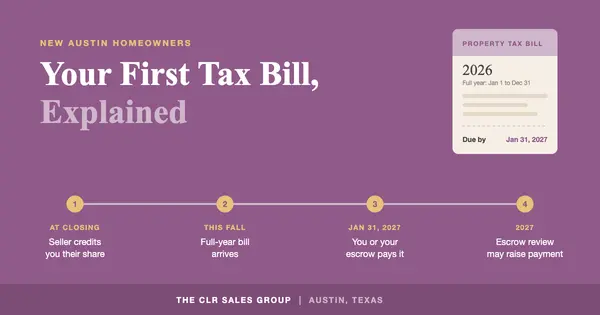
Bought an Austin Home in 2026? Your First Tax Bill Explained
I bought a home in Austin in 2026. Why is my first property tax bill for the whole year? In Texas, property taxes are paid once a year, after the year they cover. If you closed in 2026 before the bill was issued, the seller credited you at closing for their share of the year (January 1 to your closi

Sell Your Austin Home Over the Holidays or Wait for Spring?
Should you sell your Austin home over the holidays or wait for spring? Listing over the holidays in Austin means far less competition: Unlock MLS counted about 1,900 new listings across the Austin area last December, compared with about 3,500 this September, and closed sales held up that December. S
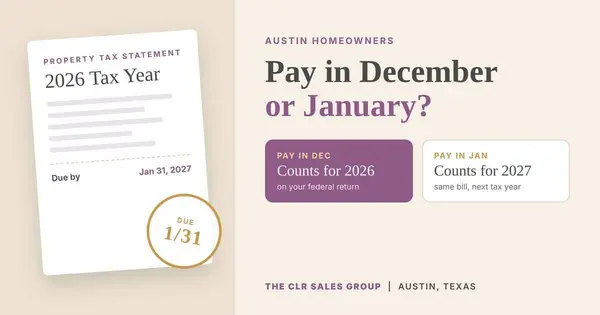
Pay Your Austin Property Tax Bill in December or January?
Should you pay your Austin property tax bill in December or January? Austin-area property tax bills for 2026 are due by January 31, 2027, and penalties start February 1. Paying in December or January costs the same, but the tax year it counts in is different: a December payment generally counts towa