
I bought a home in Austin in 2026. Why is my first property tax bill for the whole year?
In Texas, property taxes are paid once a year, after the year they cover. If you closed in 2026 before the bill was issued, the seller credited you at closing for their share of the year (January 1 to your closing date), and now you or your lender's escrow account pay the full 2026 bill by January 31, 2027. Because the estimate at closing used last year's numbers, your escrow account may come up short next year, which can raise your monthly payment.
By Carmen Reese | The CLR Sales Group | November 13, 2026
Congratulations on your first year in your home. Now comes the part nobody really explains at the closing table: your first Texas property tax bill.
Every fall, I get texts from past clients that start with "Is this right?" They're looking at a bill for the entire year, even though they only owned the home for a few months. Or they've just heard from their lender that their payment is going up. Both are normal, and both make a lot more sense once you see how the money moved at closing.
Why you're paying the full year's bill
Texas property taxes are billed in the fall and due by January 31 of the next year. So when you bought your home in 2026, the 2026 bill didn't exist yet.
Here's how the TREC contract handles that, as Independence Title explains it:
- If the bill wasn't issued yet at closing (most 2026 closings), the seller credited you for their share of the year, from January 1 to your closing date. You'll see it on your closing statement as a tax proration.
- You (or your lender) then pay the full bill. The seller's credit was their contribution. It's already in your pocket, or it went into your escrow account.
- If the bill had already been issued (common for closings in November and December), the seller usually pays it at closing and you credit them for your part of the year.
So you're not paying the seller's taxes for free. You got their share up front.
Why the bill doesn't match what you expected
The proration at closing is an estimate. Before April 1, title companies typically use the prior year's taxes. After that, they often use the appraisal district's current value times the prior year's rates. The real bill can land higher or lower for a few common reasons:
- The seller's exemptions. Your 2026 bill reflects how the home was exempted in 2026. If the seller had a homestead exemption, an over-65 exemption, or a tax ceiling, that may show on this bill and disappear on the next one. Check the exemptions listed on your bill and on your appraisal district's site.
- New rates. Cities, counties, and school districts adopt new rates every year. The City of Austin, for example, adopted a 2026 rate of about 0.58 percent, and the City estimated the typical ratepayer pays about $9.48 a month more in city property tax.
- New construction. If you bought a new build, the January 1 value may have been the lot alone or a partly finished home. The next year's value will include the whole house, and the bill can jump. This is the one I warn every new construction buyer about.
- Special districts. A MUD, PID, or ACC rate on your address adds to the stack.
If something looks wrong, call the title company that closed your purchase. Prorations can be re-adjusted between buyer and seller if the estimate was off, and the title company can tell you whether that applies to your contract.
If you're still in the planning stage, or you know someone who is, the time to learn this is before you buy. Make sure to attend our next live Homebuyer Webinar. Register here.
Why your mortgage payment may go up in 2027
If your loan has an escrow account, your lender collects taxes and insurance each month and pays the bills for you. Once a year, the lender runs an escrow analysis. If the real tax bill or your insurance premium came in higher than the estimate, there's a shortage.
US News (via WTOP, July 2026) reported Cotality's estimate that 65% of escrow accounts would have a shortage in 2026, with an average shortage of about $2,100 and an average payment increase of about $175 a month. That's a national figure, not an Austin one, but it shows how common this is.
When the shortage letter arrives, you usually get two choices:
- Pay the shortage as a lump sum. Your new monthly payment only rises enough to cover next year's higher bills.
- Spread it over 12 months. No big check, but your payment goes up by more for the next year.
Lenders are also allowed to keep a cushion of up to two months of escrow payments, which is part of why the adjustment can feel bigger than the bill itself.
What I'd do this month
- Find your closing statement and look for the tax proration line, so you know what the seller credited you.
- Look up your bill on your county tax office site (Travis, Williamson, Hays, or Bastrop) and confirm it's being paid by January 31.
- Check your exemptions. If you haven't filed your homestead exemption yet, do it now so it's on your 2027 bill.
- Set aside money for a possible shortage so the escrow letter isn't a surprise.
Frequently Asked Questions
I closed in 2026. Do I really pay the whole 2026 tax bill?
Yes, in most cases. The seller credited you at closing for January 1 through your closing date, and you or your escrow account pay the full bill by January 31, 2027.
Why does my first bill still show the old owner's exemptions?
The 2026 bill reflects how the property was exempted for 2026. Exemptions you file as the new owner show up on later bills. Check your appraisal district record to see what's listed and when yours begins.
Why did my mortgage payment go up after my first year?
Usually because your real tax bill or insurance premium came in higher than the estimate used when you closed. Your lender's annual escrow analysis catches up the difference and adjusts your payment.
Should I pay my escrow shortage as a lump sum or monthly?
A lump sum keeps your monthly payment lower for the next year. Spreading it out avoids a big check but raises your payment more. Pick the one that fits your cash flow.
What if the tax proration at closing was wrong?
Call the title company that handled your closing. They can tell you whether your contract allows the proration to be re-adjusted with the seller.
The bottom line
Your first Texas tax bill covers the whole year because the seller already paid you their share at closing. The surprise usually isn't the bill itself, it's the escrow catch-up that follows. A few minutes with your closing statement and your county's tax site now can save you a stressful letter later.
If you bought with me and something on your bill doesn't look right, reach out and we'll walk through it together. And if you're planning your next move, book a free 15-minute consult with Carmen. If you're just getting started, here's how much you really need to buy your first home in Austin.
Sources: Independence Title, "Property Tax Time in Texas: Tax Prorations" (Oct 21, 2025); US News via WTOP, "What Is an Escrow Shortage?" (July 2026, citing Cotality); City of Austin FY2026-27 budget release (Aug 12, 2026); Travis County Tax Office. Figures as of November 2026.
About Carmen Reese
Carmen Reese is an Austin native and the founder of The CLR Sales Group at Real Broker, LLC. She has been selling homes in the Austin area for almost a decade. Before real estate she worked as a data analyst, and she is a Certified Negotiation Expert, so every pricing and offer decision starts with the numbers. Carmen and her team are RealTrends Verified in the top 1.5% of real estate professionals nationally. She hosts the weekly Homebuyer Webinar and The Austin Homebuyer Academy on YouTube.
FROM OUR BLOG

Sell Your Austin Home Over the Holidays or Wait for Spring?
Should you sell your Austin home over the holidays or wait for spring? Listing over the holidays in Austin means far less competition: Unlock MLS counted about 1,900 new listings across the Austin area last December, compared with about 3,500 this September, and closed sales held up that December. S
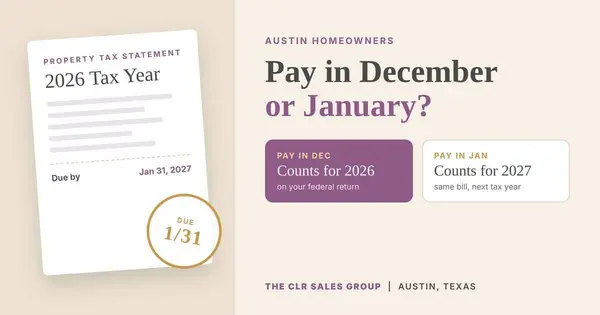
Pay Your Austin Property Tax Bill in December or January?
Should you pay your Austin property tax bill in December or January? Austin-area property tax bills for 2026 are due by January 31, 2027, and penalties start February 1. Paying in December or January costs the same, but the tax year it counts in is different: a December payment generally counts towa
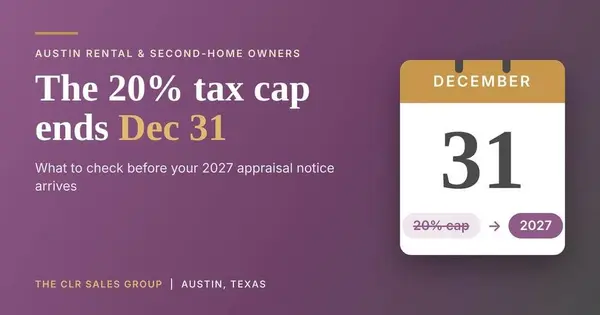
Austin Rental Owners: The 20% Tax Cap Ends Dec 31
What happens when Texas's 20% appraisal cap on rental homes ends? Texas's 20% "circuit breaker" cap on non-homestead property values expires on December 31, 2026. Starting with the 2027 tax year, an Austin-area rental or second home with a capped value below market value can be appraised at its full