
Can you back out of a new construction contract in Texas?
Sometimes, but it is harder than backing out of a resale purchase. Most builder contracts are the builder's own document, many have no option period, and the deposit terms usually favor the builder. Your real exits are whatever your contract allows (often a financing or appraisal failure backed by a written lender statement, or a builder default), and in today's Austin market, renegotiating with the builder is often a better move than walking away.
By Carmen Reese | The CLR Sales Group | November 24, 2026
If you signed on a new build in the spring or summer, a lot may have changed since then. Rates moved, your current home may not have sold, and the builder may now be offering the house down the street for less than you agreed to pay.
That last one stings. And it is happening: in the November 2026 NAHB/Wells Fargo builder survey, 46% of builders said they cut prices (the highest share since Covid), the average cut was 6%, and 68% were using sales incentives (NAHB Eye on Housing, Nov 17, 2026). Locally, Unlock MLS said in its October report that builders are "heavily relying on incentives like price reductions and mortgage rate buydowns" (via CultureMap Austin, Nov 12, 2026).
So the question I keep hearing is simple: can I get out of this?
Why a builder contract is different from a resale contract
When you buy a resale home in Texas, you almost always sign the TREC One to Four Family Residential Contract. You pay an option fee, you get an option period, and during that window you can walk away for any reason and get your earnest money back.
New construction is different in three ways:
- It is usually the builder's own contract. TREC does have New Home Contract forms (TREC 23-20 for homes still being built and 24-20 for completed homes), and Texas license holders use them. But many large builders use their own agreements, written by their attorneys.
- There is often no option period. On the TREC new home forms, the option fee buys you an unrestricted right to terminate. Builder contracts frequently leave that out. Read yours line by line.
- Deposits are often bigger and harder to get back. Your contract decides whether your earnest money is refundable and when. Some builder contracts say the builder keeps the deposit if you default. If you paid separately for upgrades or design selections, check whether that money is treated differently.
Many builder contracts also send disputes to binding arbitration instead of court. The TREC new home forms use mediation. That matters if things get tense, so know which one you agreed to.
The exits that actually exist
Here is how I walk my clients through it. Start with the contract you signed, not with what you wish it said.
1. Your financing falls through
Your builder contract decides what happens if your loan falls through, so start there. Most builder contracts have their own financing section. Some give you a financing contingency with a deadline. Some only protect you if you use the builder's preferred lender. And some have no financing contingency at all, which means not getting a loan can put you in default.
If your contract does have a financing contingency, look for three things:
- The deadline. You usually have to cancel by a specific date or within a set number of days after signing. Miss it and the protection can be gone.
- How notice has to be given. Most contracts require written notice, sent to a specific person or address listed in the contract.
- What proof you need. Many builders want a written denial from your lender before they release your deposit.
Follow those steps exactly the way your contract spells them out. That is how you give yourself the best chance of getting your earnest money back.
Two cautions:
- If you used the builder's lender to get incentives, read what happens to those incentives (and your deposit) if you switch.
- Choosing not to proceed is not the same as being denied. A lender has to actually decline.
2. The appraisal or the house fails the lender
Some builder contracts also let you cancel if the home does not satisfy your lender (appraisal, insurability, required repairs), again by a deadline and usually with written proof from the lender. With prices down in parts of the Austin area this fall, a new build signed at last spring's price can appraise short. That is a real exit if your contract includes it.
3. The builder misses its own deadlines
On the TREC new home form for incomplete construction, delays for weather, materials, and similar causes can push the completion date, but never past the closing date. Builder contracts write their own delay rules, and many give the builder a lot of room. If the builder is in default under your contract, your remedies are whatever that contract spells out.
4. You simply want out
If none of the contract's exits apply and you stop performing, you may be in default. That usually means losing some or all of your deposit, and depending on the contract, possibly more. Before you go there, talk to a Texas real estate attorney.
This is not legal advice. Contracts vary a lot from builder to builder, so have an attorney read yours before you act.
Make sure to attend our next live Homebuyer Webinar (register here). We go through financing, programs, and how to compare offers by the monthly payment, which is exactly the math you need here.
Before you walk away, ask for the deal the next buyer gets
Here is the part most buyers skip. If the builder is cutting prices or paying for rate buydowns on homes like yours, you can ask for the same help on your contract. Builders would rather keep a buyer who is ready to close than resell a finished home in a slow month.
What I would ask for, in writing:
- A price adjustment to match what similar homes in the community are listed for today
- A rate buydown or closing cost credit, compared as a monthly payment, not just a dollar figure
- Upgrades or design credits if the price itself will not move
- More time to close if you are waiting on your current home to sell
Compare every option by what it does to your payment. At 7.28% (Freddie Mac, Nov 19, 2026), a buydown can do more for your monthly number than a small price cut. If you are new to that tradeoff, my post on ARM or 30-year fixed at 7% shows how I run the numbers.
The numbers and options are usually more flexible than they feel the week you panic. The goal is to find out which ones your contract gives you before you make a move you cannot undo.
Frequently Asked Questions
Do Texas new construction contracts have an option period?
The TREC New Home Contract forms include one if you pay an option fee, but many builders use their own contracts, and those often have no option period. Read your contract to see whether you have any right to terminate for any reason.
Will I lose my earnest money if I back out of a new build in Texas?
It depends on your contract. If you terminate under a contract right (for example, a financing or appraisal failure backed by a written lender statement, on time), you usually get it back. If you walk away without a contractual reason, many builder contracts let the builder keep some or all of the deposit.
Can I renegotiate my new construction price if the builder cut prices?
You can ask, and in a slow market many builders will listen. Ask for a price adjustment, a rate buydown, closing cost help, or upgrades, and compare each one as a monthly payment.
Does a low appraisal let me cancel a new construction contract in Texas?
It can, if your contract includes a financing addendum with property approval like TREC's Third Party Financing Addendum. You would need to terminate by its deadline with a written statement from your lender.
Should I talk to an attorney before backing out of a builder contract?
Yes. Builder contracts often include deposit forfeiture and arbitration clauses, and the details decide what you can recover. A Texas real estate attorney can tell you where you stand before you stop performing.
Backing out of a Texas new build comes down to what your contract says, and the best outcome is often a better deal on the same house rather than walking away from your deposit.
If you are under contract with a builder and want a second set of eyes on your options, book a free 15-minute consult with Carmen. And make sure to attend our next live Homebuyer Webinar (register here).
Sources: NAHB/Wells Fargo Housing Market Index via NAHB Eye on Housing (Nov 17, 2026); Unlock MLS October 2026 Central Texas Housing Report via CultureMap Austin (Nov 12, 2026); Texas Real Estate Commission New Home Contract forms (TREC 23-20 and 24-20); Freddie Mac Primary Mortgage Market Survey (Nov 19, 2026). Rates as of mid-November 2026.
About Carmen Reese
Carmen Reese is an Austin native and the founder of The CLR Sales Group at Real Broker, LLC. She has been selling homes in the Austin area for almost a decade. Before real estate she worked as a data analyst, and she is a Certified Negotiation Expert, so every pricing and offer decision starts with the numbers. Carmen and her team are RealTrends Verified in the top 1.5% of real estate professionals nationally. She hosts the weekly Homebuyer Webinar and The Austin Homebuyer Academy on YouTube.
FROM OUR BLOG


Keep Your Over-65 Tax Ceiling When You Move in Texas
Can you keep your over-65 property tax ceiling when you move in Texas? Yes, partly. When you sell a home with an over-65 (or disabled) school tax ceiling and buy a new homestead in Texas, the ceiling can transfer, but as a percentage, not a dollar amount. If you were paying 25% of what your school t

Buying or Selling an Austin Home With Solar Panels
What happens to solar panels when you buy or sell a home in Austin? It depends on whether the panels are owned, financed, or leased. Owned panels simply convey with the house. Financed or leased panels come with a contract that has to be paid off at closing or transferred to the buyer, and in Texas
Austin ECAD Energy Audit: What Home Sellers Must Do
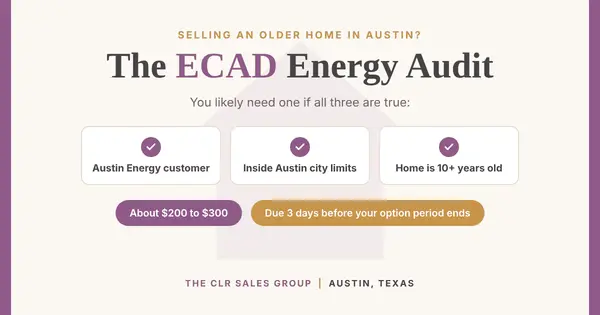
Do you need an ECAD energy audit to sell your home in Austin? Yes, if your home is inside Austin city limits, served by Austin Energy, and 10 years old or older. Under the City of Austin's Energy Conservation Audit and Disclosure (ECAD) ordinance, you need an energy audit from a certified auditor (o