
How much more house does your money buy in Austin than in California?
A lot more, if you're coming from the Bay Area, Los Angeles, or San Diego. Based on each city's median price per square foot, the same 2,000 square foot home runs about $1.23 million in Los Angeles and $1.69 million in San Jose, versus about $598,000 inside the City of Austin and about $386,000 in Round Rock. Texas has no state income tax, but property taxes are higher than under California's Prop 13, so run the full monthly payment on a real house before you decide.
Watch on YouTube: Moving From California to Austin: What Your Money Buys Now
By Carmen Reese | The CLR Sales Group | November 3, 2026
If you live in California and you've been looking at Austin, I'm guessing you've done the late-night Zillow math. You type in your budget, you see the size of the houses, and you think, that can't be right. There has to be a catch.
There is a catch. Actually, there are a couple. But the money part is real.
I was born and raised in Austin, I was a data analyst before I was a realtor, and I've been selling homes here for almost a decade. Every week I talk to people from California who are trying to figure out if this move actually works on paper. Here's how I walk them through it: the same house priced in five California cities and here in Austin, what your California equity does when you bring it here, the honest tax math, and the three California buying habits that cost people money the minute they get to Texas.
The Same House, Priced in California and in Austin
Let's start with the fairest comparison I know. Not median price, because a median in San Francisco and a median in Round Rock are totally different houses. Price per square foot.
Picture one house, 2,000 square feet. Here's roughly what it sells for, based on the median price per square foot in each city over the three months ending in August:
- San Francisco: about $2.28 million ($1,140 per square foot)
- San Jose: about $1.69 million ($847 per square foot)
- San Diego: about $1.34 million ($670 per square foot)
- Los Angeles: about $1.23 million ($613 per square foot)
- Sacramento: about $650,000 ($325 per square foot)
- City of Austin: about $598,000 ($299 per square foot)
- Round Rock (about 25 minutes north): about $386,000 ($193 per square foot)
A quick data note, because I'd want you to hear it from me. Price per square foot is an average. A house at the top of a market costs more per foot than one at the bottom. So treat this as a ruler, not a quote.
But as a ruler, it tells the story. If you're coming from the Bay Area, LA, or San Diego, the same house here can cost a third to a half of what you'd pay at home, and sometimes less. If you're coming from Sacramento, the gap is smaller, and I'll be honest about that too. Inside Austin it's close to even. Your big savings show up when you look north and east of the city.
What Your California Equity and Taxes Actually Do Here
The payment difference
The median California home sold for about $901,000 in August. The median home across the whole Austin metro was about $412,000.
Run the payment on both with the same 20 percent down at a rate of about 7.4 percent:
- California median: about $4,993 a month in principal and interest
- Austin-area median: about $2,282 a month in principal and interest
That's before taxes and insurance, and we'll get to taxes. But that's the core of the difference.
For context, the California Association of Realtors says it took an income of about $228,000 a year to qualify for the median home there this spring. A lot of the people I talk to are earning a good living and still can't make that work. Here, the math opens back up.
Three ways to use your equity
If you own a home in California, you have three ways to use that equity when you get here:
- Put more down and shrink your payment.
- Keep the payment you're used to and buy more house.
- Buy comfortably and keep a real cash cushion in the bank. This is my favorite for a lot of people.
Same equity, three very different lives. Which one is right depends on you, and that's exactly what we map out together.
The honest tax math
Okay. The catch I promised.
Texas has no state income tax. If you're earning a California income, look at the state tax line on your last pay stub. That line goes away when you move here.
But property tax is higher here, and if you've owned your California home for a long time, this part can feel like a shock. In California, Prop 13 sets your base rate around 1 percent and caps how fast your assessed value can rise at 2 percent a year. If you bought fifteen years ago, you may be paying tax on a value that's a fraction of what your house is worth today.
In the Austin area, the combined rate depends on the city and school district. It runs roughly 1.7 to a little over 2 percent before exemptions. For the 2025 tax year, that was about 1.68 percent in Round Rock, about 1.94 percent in the City of Austin, and about 2.14 percent in Pflugerville.
On your primary home, the homestead exemption takes the first $140,000 off the school district part of your value and caps how fast your taxable value can rise.
So here's how I'd think about it. You give up a state income tax and take on a higher property tax. For most working households coming from California, the total goes down. For a retired couple with a tiny Prop 13 bill and not much income, it can be closer to a wash. Run your number on your house, not a headline.
This is general education, not tax, legal, or lending advice. Confirm your numbers with your CPA and your lender.
If you want to see how these numbers and programs work for your situation, make sure to attend our next live Homebuyer Webinar.
Where Your Budget Lands Around Austin
So where does your money actually land? Here's how I'd sort it.
Under about $450,000: north, east, and south suburbs. Round Rock's median sale price is about $384,000, Leander about $430,000, and Pflugerville about $360,000. South in Hays County, around Buda and Kyle, the county median is about $355,000. This is where you get the newer home and the bigger lot.
About $500,000 to $600,000: Cedar Park and the City of Austin. Cedar Park's median is around $520,000, and the City of Austin's median is about $560,000. This is where you give up some square footage for being closer in.
The close-in tier inside the city. The neighborhoods right up against downtown: Clarksville, Zilker, Brentwood, Allandale, and just west of the river, Westlake and Barton Creek. These are pricier. Being ten minutes from downtown is a big part of it, but it's also the feel: walkable streets, restaurants and coffee shops, old oaks, the trail and Zilker Park close by. If you're coming from San Francisco or the Westside of LA, this is the part of Austin that will likely feel most like the life you're used to. Your budget starts higher here, but so does what you get for it.
Above that: West Austin and the Hill Country. Lakeway, Bee Cave, and Dripping Springs. Views, hills, water, and a quiet that a lot of my California clients say reminds them of home. If you're coming from Orange County or the Peninsula, this is where your equity tends to want to go.
My advice: don't pick from a spreadsheet. Pick two of these areas, come out for a weekend, and drive them at 8 in the morning and 6 at night.
The California Habits That Cost You Money in Austin
California buyers are some of the most prepared buyers I work with. They're also the most likely to overpay here, because they're playing by California rules in a Texas market.
Habit 1: Offering over asking by reflex
In California, that's how you win. In Austin right now, about 82 percent of homes are selling below their asking price, and there are about five months of inventory across the metro. That's a buyer's market. You don't need to race anyone. You need to negotiate.
Habit 2: Skipping the asks
Right now, sellers paying closing costs is standard on a lot of deals, and rate buydowns are common in the $400,000 to $700,000 range. Here's what that's worth:
- On a $400,000 home with 3 percent down at about 7.4 percent, a 2-1 buydown costs the seller about $9,200
- It lowers your payment about $507 a month in year one
- And about $259 a month in year two
That's real money, and in a California bidding war, you'd never even ask for it.
Habit 3: Shopping by price instead of payment
A cheaper house with a higher tax rate can cost you more every month than a pricier house with a lower one. Two homes at the same price can carry very different tax bills here. So we always compare the full monthly payment, house by house.
If I were moving from California right now
- Get a real number on my California equity, after the costs of selling.
- Run my Texas tax math on an actual house: income tax there versus property tax here.
- Pick two areas and come see them.
- Negotiate like it's a buyer's market, because it is. Price, closing costs, the rate, all of it.
And if you're selling in California and buying here, we plan both sides together, so you're not carrying two payments or stuck without a place to land. That timing is a big part of what my team does.
Frequently Asked Questions
Is Austin cheaper than California for the same size house?
For most of California, yes. Using each city's median price per square foot (three months ending August 2026), a 2,000 square foot home runs about $1.23 million in Los Angeles and $1.34 million in San Diego, versus about $598,000 in the City of Austin and about $386,000 in Round Rock. Sacramento is closer to Austin, at about $650,000.
Are property taxes higher in Austin than in California?
Yes. Austin-area combined rates run roughly 1.7 to a little over 2 percent before exemptions, compared to California's Prop 13 base of about 1 percent with a 2 percent yearly cap on assessed value. Texas has no state income tax, so for most working households coming from California the total tax bill goes down, but you should run the math on a specific house.
What is the Texas homestead exemption?
On your primary residence, the homestead exemption takes the first $140,000 off the school district portion of your taxable value and caps how fast your taxable value can rise each year. You apply for it through your county appraisal district after you buy.
Should I offer over asking when buying in Austin?
Usually not right now. About 82 percent of Austin homes are selling below asking, and there are about five months of inventory, which makes it a buyer's market. Instead, negotiate on price, seller-paid closing costs, and a rate buydown.
Where should I look in Austin if my budget is under $450,000?
Look at the north, east, and south suburbs. Round Rock's median sale price is about $384,000, Pflugerville about $360,000, and Leander about $430,000, and the Hays County median (Buda and Kyle) is about $355,000. These areas tend to offer newer homes and bigger lots for the money.
Your Next Step
The money part of a California-to-Austin move is real. The catch is the property tax, and the bigger risk is bringing California buying habits into a Texas buyer's market. The way to get it right is to run your own equity, tax, and payment numbers on actual houses.
Grab my free Moving to Austin Guide for the taxes, the areas, and a relocation timeline in one place. Make sure to attend our next live Homebuyer Webinar (register here). And if you are ready to talk about your own numbers, your equity, your taxes, and your payment, book a free 15-minute consult with Carmen.
Sources: Redfin city housing market pages, median sale price per square foot and median sale price, three months ending August 2026 (Cedar Park July 2026), read October 11, 2026. California Association of Realtors August 2026 home sales report (statewide median $901,420, released September 16, 2026) and Q2 2026 Housing Affordability Index (qualifying income about $228,400). Unlock MLS August 2026 Central Texas Housing Report (Austin metro, City of Austin, and Hays County medians; 5.1 months of inventory). Freddie Mac Primary Mortgage Market Survey, October 8, 2026 (7.40%). Payments are principal and interest only on a 30-year fixed loan. Below-asking share: Redfin via CultureMap, September 22, 2026. Concessions and buydown frequency: Neuhaus Realty, May 2026 (observational). Tax rates: 2025 tax year, compiled September 2026; homestead exemption per the Texas Comptroller. Price per square foot comparisons are estimates; individual homes vary.
About Carmen Reese
Carmen Reese is an Austin native and the founder of The CLR Sales Group at Real Broker, LLC. She has been selling homes in the Austin area for almost a decade. Before real estate she worked as a data analyst, and she is a Certified Negotiation Expert, so every pricing and offer decision starts with the numbers. Carmen and her team are RealTrends Verified in the top 1.5% of real estate professionals nationally. She hosts the weekly Homebuyer Webinar and The Austin Homebuyer Academy on YouTube.
Carmen Reese, REALTOR® | The CLR Sales Group | Real Broker, LLC | Texas License #711211
FROM OUR BLOG

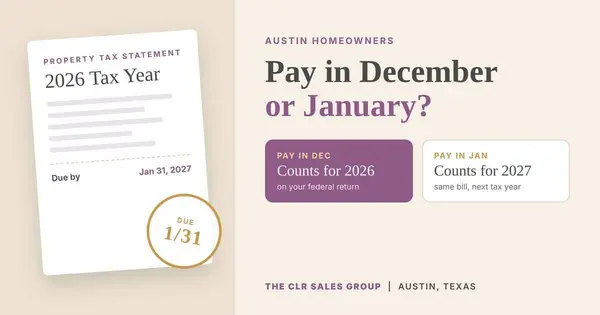
Pay Your Austin Property Tax Bill in December or January?
Should you pay your Austin property tax bill in December or January? Austin-area property tax bills for 2026 are due by January 31, 2027, and penalties start February 1. Paying in December or January costs the same, but the tax year it counts in is different: a December payment generally counts towa

Austin Rental Owners: The 20% Tax Cap Ends Dec 31
What happens when Texas's 20% appraisal cap on rental homes ends? Texas's 20% "circuit breaker" cap on non-homestead property values expires on December 31, 2026. Starting with the 2027 tax year, an Austin-area rental or second home with a capped value below market value can be appraised at its full

First-Time Home Buyer in Austin: How Much You Really Need
How much money do you need to buy your first home in Austin? On a $400,000 home in the Austin area, a first-time buyer can put as little as 3% down ($12,000), and cash to close lands around $23,000 once closing costs, inspection, and appraisal are counted. The monthly all-in, with taxes, insurance,