
What is happening in the Austin housing market right now?
Fewer homes are selling in the Austin area, but prices haven't dropped. Closed sales fell 14.8% from a year ago to 2,223, while the median home price in Austin rose 1.4% to $421,000, with 5.4 months of inventory, which is a balanced market. Buyers stepped back because of the monthly payment at today's mortgage rates, not because homes got cheaper.
Watch on YouTube: Austin Housing Market November 2026: Fewer Sales, Higher Prices
By Carmen Reese | The CLR Sales Group | November 18, 2026
Fourteen point eight percent. That's how many fewer homes sold across the Austin area this fall compared to a year ago. And prices still went up.
These are the newest numbers from our MLS (Unlock MLS, September 2026 report), and I'm going to walk you through what they mean for you, whether you're buying, selling, or thinking about moving here.
That is not a crash, and it's not a comeback either. Buyers stepped back because of the payment, not because homes got cheaper.
I'm Carmen Reese with The CLR Sales Group at Real Broker. I was a data analyst before I was a Realtor, I'm an Austin native, and I've been selling homes here for almost a decade. If you want to know what these numbers mean for your house or your budget specifically, you can book a free 15-minute consult with Carmen. Otherwise, here's the whole picture.
The Austin market at a glance
Two things moved this fall: sales dropped hard, and prices edged up. Everything else on this list explains why those two can happen at the same time.
- Median home price in the Austin area: $421,000, up 1.4% from a year ago
- Closed sales: 2,223, down 14.8%
- New listings: 3,546, up 2.8%
- Active listings: 13,465, down 3.4%
- Months of inventory: 5.4, which means balanced. Not a seller's market, and not a fire sale either
- Average days on market: about 73, so a little over two months (Realtor.com)
- Sold price vs. original asking price: about 93%, up from about 91% a year ago
Price: sales are down, but prices are not falling
The typical home in the Austin area sold for $421,000 this fall, up 1.4% from a year ago. If you've heard "sales are down, so prices must be falling," this is the number that proves that false.
What it doesn't mean is that every home is going up. Price moves block by block, and the numbers are different depending on your location and your neighborhood. Below, I'll show you two counties going in opposite directions.
Supply: why prices held
A few more sellers listed this fall than last year (new listings up 2.8%), but the total pile of homes for sale actually shrank by 3.4%.
That's why prices held. Buyers slowed down, but sellers didn't flood the market.
Months of inventory is a simple way to read that balance: it's roughly how long it would take to sell every home on the market if nothing new were listed. At 5.4 months, we're on the buyer-leaning side of balanced. So if you're shopping, you still have options, and you have time to compare them instead of rushing into the first house you see.
Speed: how close sellers are getting to asking
Homes are averaging about 73 days on the market, and on average they sold for about 93% of their original asking price this fall. A year ago, that number was about 91%.
So buyers still have room, roughly seven percent off where homes first listed, but that gap got a little smaller.
Put it all together and you've got fewer buyers, steady prices, and a little less of a discount. That's a balanced market, and the whole story is about the payment.
What to do if you're buying, selling, or moving here
If you're buying
The rate is the part that hurts, so negotiate for it. Ask the seller to put money toward buying your rate down, instead of only fighting over the price. A buydown means the seller pays up front to lower your interest rate, which lowers your monthly payment, and in a balanced market with fewer buyers, sellers are more open to that conversation.
And know your monthly number before you ever tour a house. That's the number that decides everything else: which price range you shop, how much you ask the seller for, and whether a buydown or a price cut helps you more.
If you'd like to walk through how a rate buydown and the loan programs work before you start touring, make sure to attend our next live Homebuyer Webinar.
If you're selling
The good news first: your home did not lose value because sales slowed down. The median went up.
The honest part is that there are fewer buyers out there, so the homes that sit are the ones priced for a market that already passed. Price to today's market on day one. With homes averaging a little over two months on the market, the first few weeks are when your listing gets the most attention, and a price that's right from the start protects you from chasing the market down later.
If you're moving up or right-sizing
A rate buydown credit often does more for a buyer's payment than the same amount of money taken off the price. So let's run your numbers both ways before you decide how to list or how to offer.
If you're moving here
If you're coming from California or another pricier market, the spread here is big. The median inside the City of Austin is about $571,000, and the median in Williamson County is about $395,000.
My advice is to pick where your day happens first (your work, your commute, the things you love doing), and then let me show you two or three areas that fit the payment.
Travis County vs. Williamson County
This is the part a national headline will never tell you.
Travis County:
- Median about $497,000, up about 2.5% from last year
- Inventory down about 6%
- About 5.8 months of supply: balanced, leaning toward buyers, but sellers are holding their price
Williamson County:
- Median about $395,000, down about 2.5%
- New listings up almost 8%
- If you're selling in Round Rock, Georgetown, Cedar Park, or Leander, you've got more company than you did a year ago
Here's the spread: Williamson's median is about $100,000 below Travis. For a buyer, that's real money. For a seller in Williamson County, it means pricing right matters even more.
In both counties, homes sold for right around 93% of their original asking price. So there's room to negotiate on both sides of the county line.
Rates: what this market actually costs you
Rates have been sitting right around 7.4% this fall. A year ago they were about 6.25%.
On a $395,000 home with 3% down, that's about $289 a month more than the same exact home at last year's rate. That right there is the real reason sales fell.
Nobody can promise you where rates go next, and that includes me, so plan around a payment you can live with today.
My take
This is my opinion, not a forecast: prices are not the problem in Austin right now. The payment is. And payments can be negotiated in ways that prices can't.
- If you're buying, negotiate the rate.
- If you're selling, price it right on day one.
- If you're moving here, compare at least two areas before you fall in love with one.
Frequently Asked Questions
Are home prices falling in Austin in fall 2026?
No. The median home price in the Austin area was $421,000 in the latest Unlock MLS report (September 2026), up 1.4% from a year ago. Sales fell 14.8%, but prices held because the number of homes for sale shrank by 3.4%.
Is Austin a buyer's or seller's market right now?
It's a balanced market. The Austin area has about 5.4 months of inventory, which sits on the buyer-leaning side of balanced, and homes are selling for about 93% of their original asking price, so buyers still have room to negotiate.
Why did Austin home sales drop?
The monthly payment. Mortgage rates were around 7.4% this fall versus about 6.25% a year ago, which adds about $289 a month on a $395,000 home with 3% down. Buyers stepped back because of the payment, not because homes got cheaper.
What is the median home price in Travis County vs. Williamson County?
Travis County's median was about $497,000, up about 2.5%, while Williamson County's was about $395,000, down about 2.5% (Unlock MLS, September 2026). That's roughly a $100,000 difference between the two counties.
How long does it take to sell a home in Austin right now?
Homes are averaging about 73 days on the market (Realtor.com), a little over two months. Pricing to today's market on day one matters, because the homes that sit are usually priced for a market that has already passed.
Your next step
Austin's prices are holding, sales are down, and the payment is the real story. The good news is that payments can be negotiated in ways prices can't, whether you're buying, selling, or moving here.
Make sure to attend our next live Homebuyer Webinar (register here). And if you'd like to walk through what these numbers mean for your house or your budget, book a free 15-minute consult with Carmen.
Sources: Unlock MLS Central Texas Housing Report, September 2026 data (released Oct 13, 2026): Austin-area median $421,000 (+1.4%), closed sales 2,223 (-14.8%), new listings 3,546 (+2.8%), active listings 13,465 (-3.4%), 5.4 months of inventory, 92.7% of original list price (vs. 91.4%); Travis County median $497,400 (+2.6%), inventory -6.1%, 5.8 months, 92.5%; Williamson County median $395,000 (-2.5%), new listings +7.7%, 93.0%; City of Austin median $570,958. Days on market: Realtor.com, late summer 2026. Rates: Freddie Mac Primary Mortgage Market Survey, Oct 15, 2026 (7.40%; 6.27% a year earlier). Payment math: standard 30-year amortization, principal and interest only, $395,000 with 3% down.
About Carmen Reese
Carmen Reese is an Austin native and the founder of The CLR Sales Group at Real Broker, LLC. She has been selling homes in the Austin area for almost a decade. Before real estate she worked as a data analyst, and she is a Certified Negotiation Expert, so every pricing and offer decision starts with the numbers. Carmen and her team are RealTrends Verified in the top 1.5% of real estate professionals nationally. She hosts the weekly Homebuyer Webinar and The Austin Homebuyer Academy on YouTube.
FROM OUR BLOG

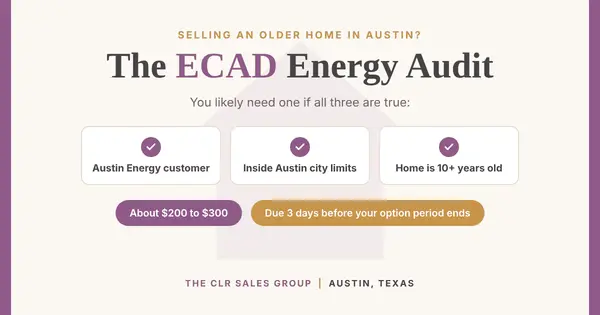
Austin ECAD Energy Audit: What Home Sellers Must Do
Do you need an ECAD energy audit to sell your home in Austin? Yes, if your home is inside Austin city limits, served by Austin Energy, and 10 years old or older. Under the City of Austin's Energy Conservation Audit and Disclosure (ECAD) ordinance, you need an energy audit from a certified auditor (o
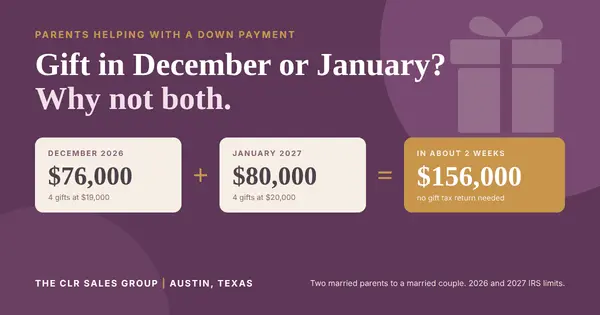
Gifting a Down Payment in Texas: December or January?
Should parents gift a down payment in December or January? If your parents are helping with your Austin down payment, timing around December 31 can double what they give without touching their lifetime exemption. In 2026 each person can give $19,000 per recipient without filing a gift tax return, an

Closing on an Austin Home Before Dec 31: Worth It?
Is it worth closing on an Austin home before December 31? Closing before December 31 can help if you plan to itemize deductions for 2026: points you pay on a purchase loan, the mortgage interest you prepay at closing, your share of 2026 property taxes, and (new for 2026) mortgage insurance can all c